
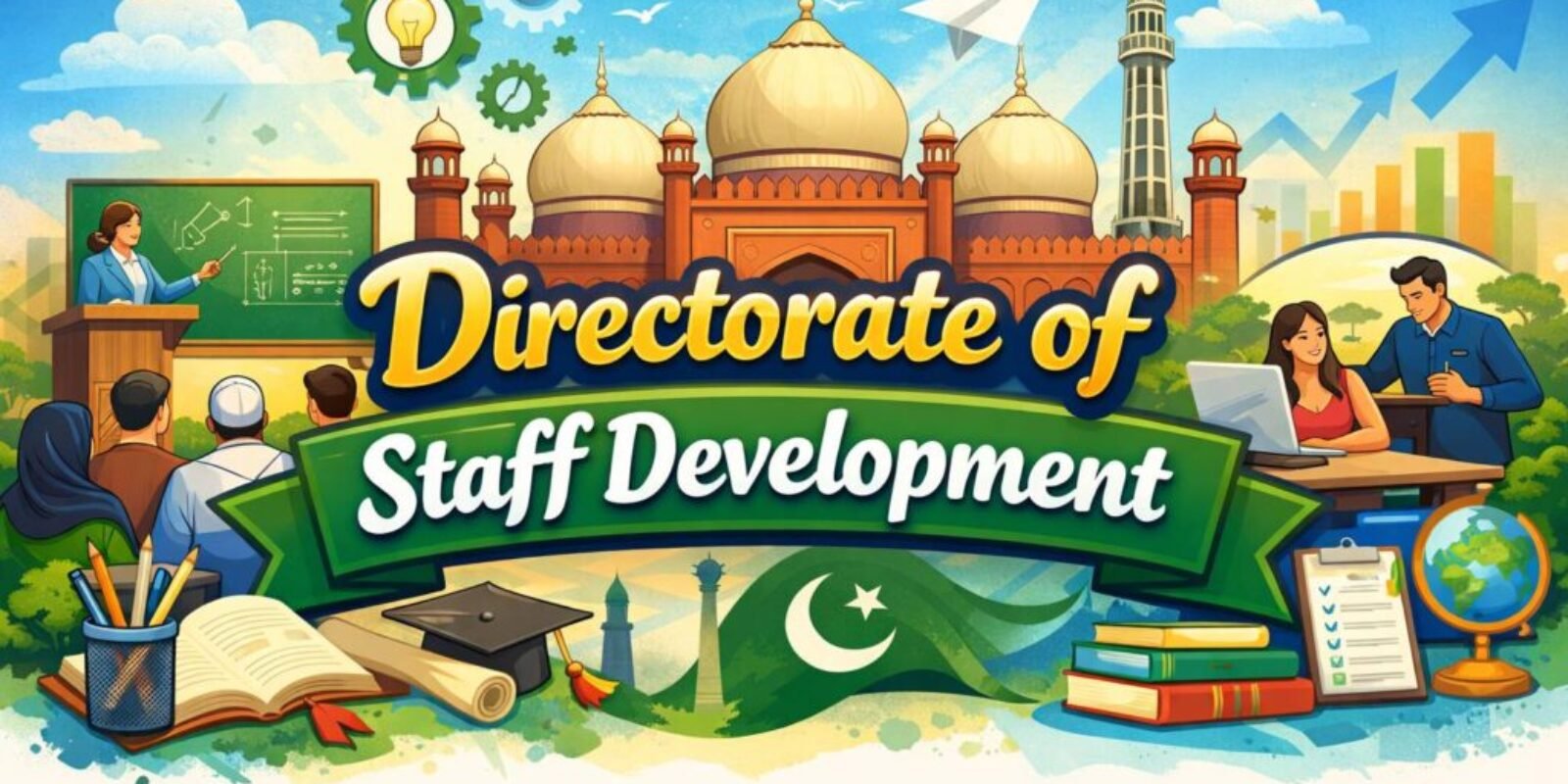
Directorate of Staff Development: Teacher Programs
The Directorate of Staff Development is a government institution in Punjab, Pakistan, focused on strengthening the quality of public education through teacher and leadership training. It was created to address a core issue in education systems: improving classroom outcomes by investing in the people who deliver them. Instead of focusing only on curriculum or infrastructure, it targets professional skills, teaching methods, and institutional capacity.
Over time, its role has expanded beyond basic training sessions to structured development programs, monitoring frameworks, and policy support. It now operates under the reformed structure of QuaideAzam Academy for Educational Development, reflecting a broader and more modern approach to educator development. Understanding how it functions helps teachers, administrators, and policymakers make better decisions about training, career growth, and school improvement.
What is the role of the Directorate of Staff Development in education?
The Directorate of Staff Development exists to improve teaching quality by providing structured professional development to educators. Its primary role is to design training systems that help teachers adopt effective classroom practices, rather than relying only on subject knowledge or experience.
In practical terms, it develops standardized training modules aligned with national and provincial curriculum goals. These modules cover pedagogy, assessment methods, classroom management, and student engagement strategies. The aim is consistency across schools, especially in public sector institutions where disparities are common.
Another important function is capacity building at scale. Instead of training individuals in isolation, it works through master trainers and cluster-based systems. This allows training to reach thousands of teachers while maintaining a degree of quality control.
It also plays a policy-support role. Insights gathered from training sessions and classroom observations often inform broader education reforms. This creates a feedback loop between policy and practice, which is essential for long-term improvement.
How does it support teachers and school leaders in practice?
The institution supports educators through structured, ongoing training rather than one-time workshops. Teachers are engaged in continuous professional development cycles that include instruction, practice, and evaluation.
Training programs often combine theory with classroom application. For example, a session on student-centered learning is typically followed by guided implementation in real classrooms. This reduces the gap between learning a concept and actually using it.
School leaders such as headteachers receive separate training focused on management, supervision, and instructional leadership. This ensures that school environments support the changes teachers are expected to implement.
Monitoring is another key element. Trainers or field officers observe classrooms and provide feedback, helping teachers refine their approach. This practical feedback loop is often more valuable than the initial training itself, as it addresses real challenges faced on the ground.
What changed after its transition to QAED?
The transition to QAED reflects a shift from a training-focused model to a more comprehensive professional development system. While the core mission remains the same, the structure and delivery methods have evolved.
One major change is the emphasis on research-based training. Programs are increasingly aligned with evidence from education studies, making them more relevant and effective. This also improves credibility among educators and policymakers.
Another shift is toward institutional strengthening. Instead of focusing only on individual teachers, QAED works on improving entire school systems, including leadership practices and organizational culture.
Technology integration has also improved. Digital platforms, blended learning models, and data tracking systems are now part of training delivery. This allows better scalability and monitoring, especially in large education systems like Punjab’s.
Also Read: Graduations Pouch Pizza Purchase Game Zippergitsfh
How should educators evaluate its training programs?
Educators should assess training programs based on practical impact rather than content alone. A useful question is whether the training leads to measurable improvements in classroom teaching and student engagement.
Relevance is another key factor. Training should align with the actual challenges teachers face, such as large class sizes, limited resources, or diverse learning needs. Programs that ignore these realities tend to be less effective.
Consistency and follow-up matter as well. One-off sessions rarely lead to lasting change. Effective programs include ongoing support, feedback mechanisms, and opportunities for reflection and improvement.
It is also important to evaluate the trainers themselves. Experienced trainers who understand classroom realities tend to deliver more meaningful sessions compared to purely theoretical instructors.
What are the common challenges and limitations to consider?
Despite its structured approach, the system faces several practical challenges. One common issue is the gap between training content and classroom realities, especially in under-resourced schools.
Scalability can also affect quality. When training is delivered to large numbers of teachers, maintaining consistency becomes difficult. This sometimes leads to variations in how content is understood and applied.
Another limitation is resistance to change. Teachers who are used to traditional methods may find it difficult to adopt new practices, even after training. Without strong leadership support, implementation often remains partial.
Monitoring systems, while useful, can sometimes become procedural rather than developmental. If feedback is treated as a checklist instead of meaningful guidance, its effectiveness is reduced.
Also Read: Nation of Brunei the Abode of Peace: Culture and Stability
Conclusion
The Directorate of Staff Development, now operating as QAED, plays a central role in improving education quality in Punjab by focusing on the people who shape learning outcomes. Its structured approach to training, leadership development, and system-wide improvement reflects a long-term commitment to educational reform.
For educators and administrators, its value lies not just in attending training sessions but in applying, evaluating, and adapting what is learned. Understanding both its strengths and its limitations allows stakeholders to make informed decisions and use its programs more effectively in real classroom settings.
Frequently Asked Questions (FAQs)
1. What is Directorate of Staff Development and what does it do?
The Directorate of Staff Development is a public sector body focused on improving teacher quality through structured training programs. It designs professional development systems that help educators apply better teaching methods in classrooms.
2. Is the Directorate of Staff Development still active today?
The institution now operates as QuaideAzam Academy for Educational Development with an expanded role. Its core function remains teacher and school leadership development across Punjab.
3. Who can benefit from its training programs?
Public school teachers, headteachers, and education administrators benefit the most from its programs. These trainings are designed to improve classroom practices and school management skills.
4. How are its training programs delivered?
Programs are delivered through workshops, cluster-based sessions, and practical classroom activities. They often include follow-up support and monitoring to ensure real-world application.
5. What should educators consider before attending its training?
Educators should assess whether the training matches their classroom needs and challenges. They should also focus on applying learned methods rather than only completing sessions.